A cubic yard of soil weighs about 3,000 pounds. When a trench wall lets go, nobody in the bottom has time to climb out. Most cave-in deaths do not come from rare, unpredictable failures. They come from trenches where one of three basic rules was skipped.
We put those three rules into a 44-second short, and it took off on Instagram. Here is the longer version, with the OSHA references behind each one.
Watch the short: Trench Safety: 3 Rules That Prevent Cave-Ins
Rule 1: Protect the walls
At 5 feet and deeper, every trench needs a protective system: sloping, shoring or a shield, also called a trench box (29 CFR 1926.652(a)(1)). The only exceptions are an excavation made entirely in stable rock, or one under 5 feet where the competent person has examined it and sees no sign of a potential cave-in.
If nobody has classified the soil, the default is a slope of 1½ horizontal to 1 vertical, about 34 degrees (1926.652(b)). That gets big fast. A 10-foot-deep trench laid back at 1½:1 is 30 feet wider at the top than at the bottom. On a tight site that is rarely possible, which is why most crews end up in a trench box or shoring. Shields and shoring have to be used within the manufacturer's tabulated data or an engineer's design (1926.652(c)), and anything deeper than 20 feet needs a registered professional engineer.
A note for Arizona: hard caliche can look like rock. It only counts as stable rock if it is natural solid mineral matter that stays intact with vertical sides while exposed. Soil that has been dug before can never be classified Type A, and utility corridors across the Valley are full of previously disturbed soil.
Rule 2: Keep the edge clear
Spoil piles, materials and equipment stay at least 2 feet back from the edge, or behind a retaining device that keeps them from falling in (1926.651(j)(2)). Two things happen when spoil sits on the lip. Rocks and dirt roll in on the crew, and the extra weight on the edge pushes on a wall that is already carrying a load. Decide where the spoil goes before the excavator starts digging, not after the pile is already at the edge.
Rule 3: Always have a way out
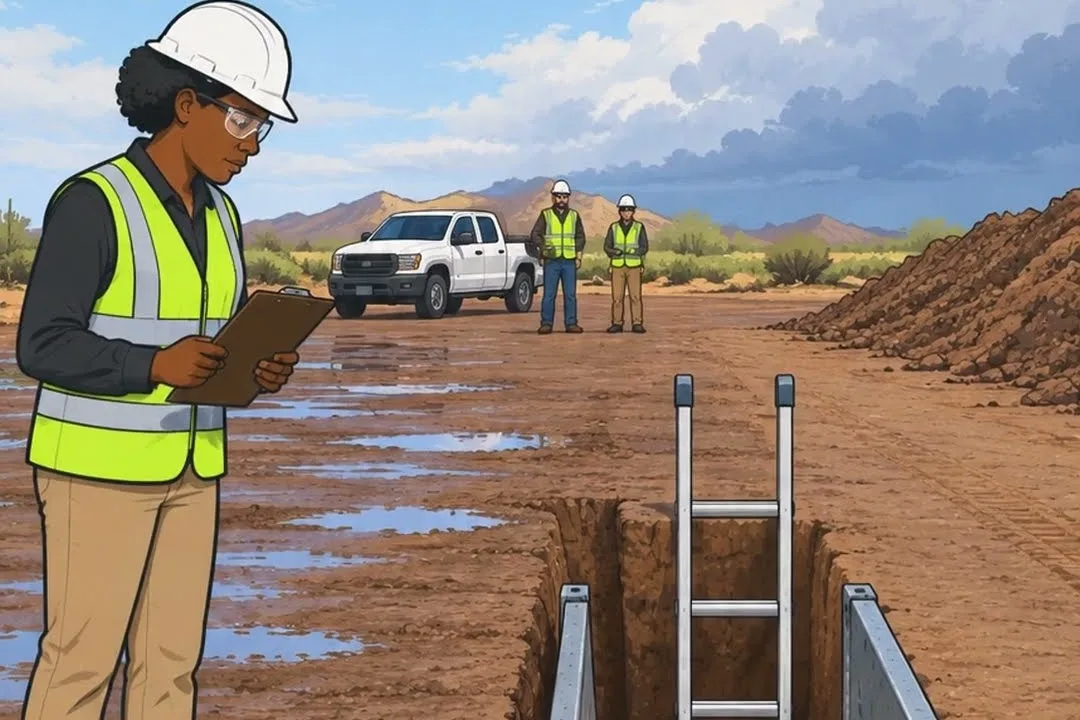
At 4 feet and deeper, the trench needs a stairway, ladder, ramp or other safe way out, close enough that no one travels more than 25 feet sideways to reach it (1926.651(c)(2)). A ladder has to extend at least 3 feet above the landing (1926.1053(b)(1)).
Notice the depth. Egress starts at 4 feet, a foot shallower than protective systems, and it is one of the most common misses we see on site. At 4½ feet a protective system may not be required, but the ladder is.
The person who makes the rules work
Every one of these rules depends on a competent person: someone trained to recognize trench hazards and authorized by the employer to fix them. The competent person inspects the trench, the area around it and the protective system every day before work starts, as needed during the shift, and after anything that raises the hazard, such as a rainstorm (1926.651(k)(1)). If they find signs of a possible cave-in, a failing protective system or a hazardous atmosphere, everyone gets out until it is fixed (1926.651(k)(2)).
In Arizona, that rainstorm line matters every monsoon season. A wall that looked fine in the morning can be a different wall after an afternoon storm.
Train your crew
P3 Safety Solutions teaches trench and excavation safety across Arizona, at your jobsite or our Phoenix training center:
- Trench & Excavation Safety: Awareness (4 hours), for laborers, equipment operators and utility crews who work in and around excavations.
- Trench & Excavation Safety: Competent Person (8 hours), for the foremen and supervisors who classify soil, choose protective systems and run the daily inspection. It can include hands-on soil classification and protective system work on an actual excavation at your site.
For more short safety lessons, subscribe to our YouTube channel and follow us on Instagram.